Background briefing · Service Spectrum
What the Park Gives Back
Ecosystem services are the benefits people obtain from nature. Sembawang Hot Spring Park is small — 1.1 hectares — but it delivers all four kinds, and each one has a different group of users behind it.
- 1.1 ha
- Park area
- 4
- Service categories
- Free
- Entry, open daily
The idea
Nature works, and people benefit
An ecosystem service is a benefit that people obtain from the processes of a natural system. The term is useful because it makes those benefits visible in decisions: a park that costs money to maintain also produces value that never appears on a receipt.
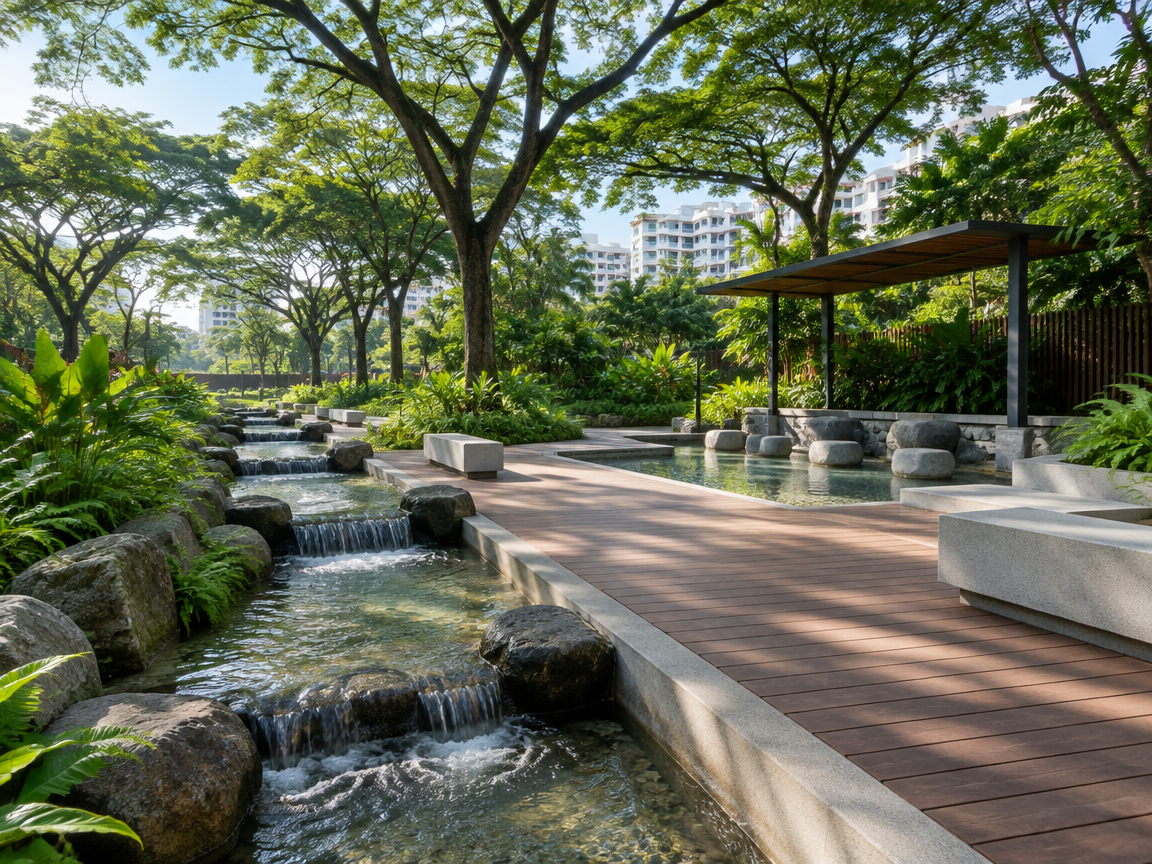
Sembawang Hot Spring Park is only 1.1 hectares — smaller than two football fields. Yet it delivers all four recognised categories of service at once, to different groups of people.
The four categories
One small park, four kinds of value
What the park produces
Provisioning
- Hot water itself — for footbaths, washing up and cooking onsen eggs at the taps
- Geothermal heat as a potential energy resource, studied by researchers
- A place-based food experience that costs nothing
Users · Families, elderly residents, day-trippers
What the park moderates
Regulating
- Shade and evaporative cooling that soften the urban heat island
- Vegetation that traps dust and improves local air quality
- Ground that absorbs stormwater instead of sending it straight to drains
- A microclimate around the water that stays humid and mild
Users · Everyone living in the surrounding HDB blocks
What the park gives people
Cultural
- Recreation, rest and the reported relief of a warm footbath
- Social contact across generations — the shared footbath is a meeting place
- Heritage and sense of place: the memory of Kampong Ayer Panas
- Education and research — a field site for geology, geography and microbiology
Users · Residents, students, researchers, visitors
What makes the rest possible
Supporting
- Habitat for thermophilic microbial mats adapted to warm mineral water
- Soil formation and nutrient cycling under the trees
- Photosynthesis and the water cycle that keep the park functioning
- Pollination and the food web that depends on the planting
Users · The ecosystem itself — and everything downstream of it
Who benefits
A park in the middle of a town
Look at where the park sits: surrounded by dense public housing in one of Singapore’s older new towns, with an ageing population and limited private outdoor space. For a resident in a nearby block, a free park within walking distance is not a luxury — it is the closest thing to a garden they have.
That context explains why the cultural services matter so much here. The footbath is a social space as much as a therapeutic one: it is used by elderly residents in the morning, by families at weekends, and by school groups in between. The park provides contact between generations that a shopping mall does not.
Trade-offs
A service can create a problem
Managing a site like this is not simply a matter of opening the gate. Every benefit carries a tension, and the park's rules exist because of them.
70°C is a hazard, not just an attraction
Scalding is a real risk. The park manages it with signage, a cascading design that cools water away from the source, and rules about where visitors may put their hands and feet.
Soap would change the water
Bathing with soap adds nutrients and chemicals to a system that is chemically stable. Keeping the water clean protects both other users and the microbial community.
Popularity has a limit
A 1.1-hectare park near dense housing can be crowded at weekends. Managing numbers, timing and behaviour is how a small site keeps delivering services without being worn out.
Key terms
- Ecosystem services
- The benefits people obtain from ecosystems — the bridge between natural processes and human wellbeing.
- Provisioning service
- A tangible product obtained from an ecosystem, such as water, food or fuel.
- Regulating service
- A process that moderates environmental conditions, such as cooling, flood buffering or air filtration.
- Cultural service
- A non-material benefit: recreation, health, identity, learning, social connection.
- Supporting service
- The underlying processes — habitat, soil formation, nutrient cycling — that enable the other three.
- Carrying capacity
- The level of use a site can absorb before its qualities begin to degrade.
Check your understanding
1 / 5