Background briefing · Deep Granite
The Geology That Keeps It Flowing
A hot spring needs three things: water, heat, and a way through the rock. In Sembawang all three are supplied by the same material — ancient granite, cracked by faults.
- ~200–250 Ma
- Age of the granite
- 420 mg/L
- Chloride in the spring water
- ~35–100 mg/L
- Chloride in tap water
Beneath your feet
A very old, very hard rock
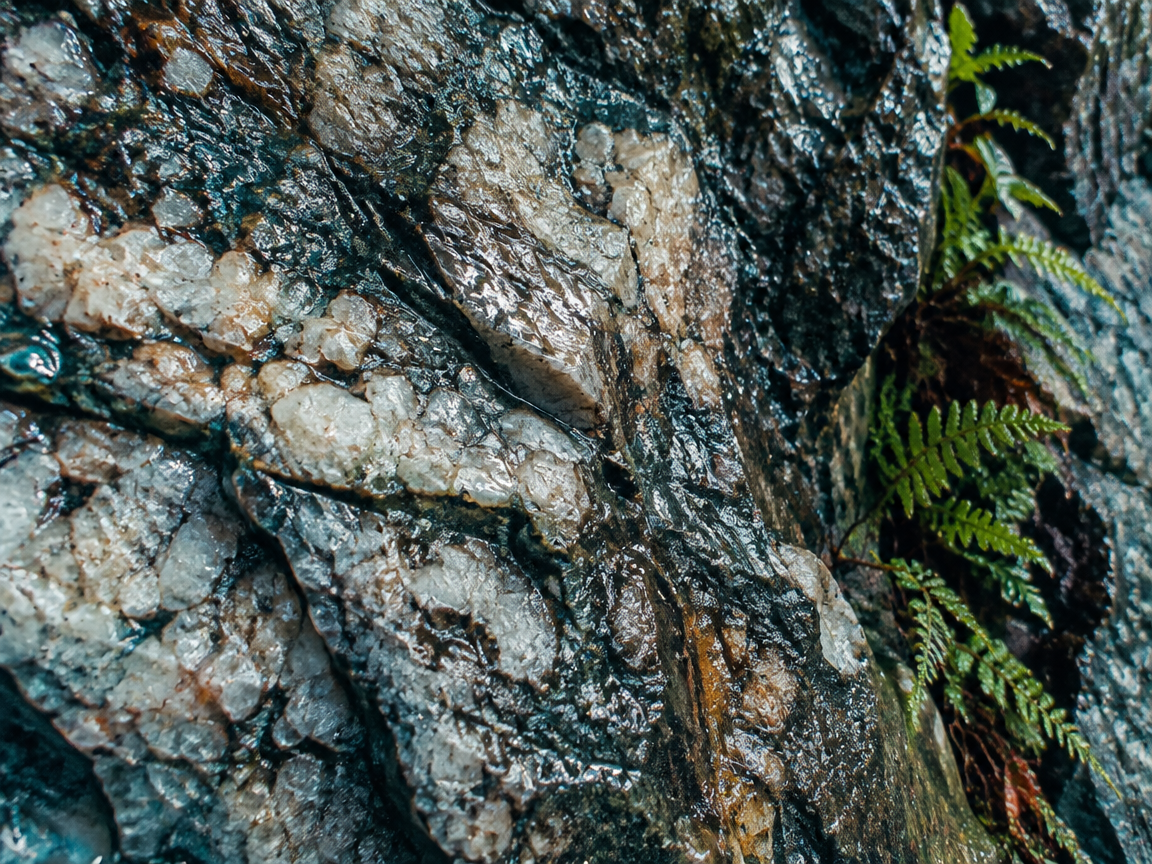
Most of Singapore's bedrock is the Bukit Timah granite, a coarse-grained igneous rock that formed deep in the crust roughly 200–250 million years ago and was later uplifted and exposed by erosion. In Sembawang it lies beneath only a thin cover of soil and weathered rock.
Granite has an important property for this story: it holds almost no water in its pores. Water can only move through it where the rock has cracked. And because granite is brittle, it cracks a great deal — into joints, faults and wide fracture zones.
The requirements
What every hot spring needs
Geologists think about hot springs as a system with four requirements. Remove any one and the spring stops. Read the table and notice how many of them Singapore's granite and climate supply at once.
Water
Tropical rainfall recharging the ground every year
A convection loop needs a continuous supply at the top of its cold limb.
Heat
Geothermal gradient plus radioactive decay in granite
Granite contains uranium, thorium and potassium, and overlying soil and rock insulate the heat.
A pathway
Joints, faults and fracture zones in brittle rock
Water cannot move through intact granite. The fracture network is both the pipe down and the pipe up.
A reservoir
A regional fracture system, not a small pocket
A large connected network holds enough water to keep the flow steady for decades.
The heat engine
Why the rock below is warmer than it should be
Two things raise the temperature. The first is depth: temperature increases with distance below the surface everywhere on Earth. The second is specific to granite — it contains small quantities of uranium, thorium and potassium, and the radioactive decay of those elements releases heat continuously.
Over millions of years, that heat accumulates in the crust. Soil and weathered rock above act as insulation, so the granite below Sembawang stays warm enough to heat water that passes through it.
The plumbing
A regional network, not a small pocket
The spring lies near the trace of a major regional structural feature — the Bentong–Raub Suture Zone, a long belt of deformed and fractured rock that runs down the Malay Peninsula. Fracture systems associated with structures like this are regional: they extend for many kilometres and stay connected over long distances.
That scale is the reason the spring sustains itself. A small sealed pocket of water would run out. A regional fracture network, continuously recharged by tropical rainfall and driven by a convection loop, does not. This is why the flow has continued for over a century and why the 1960s developers, unable to map the source, could not promise the same thing.
Chemical evidence
Reading the water as a record
The chemistry of the spring water is evidence of where it has been. Compare these measurements with ordinary treated tap water.
| Measure | Spring water | What it suggests |
|---|---|---|
| Temperature | 70°C (constant) | Steady year-round, measured on site. |
| Chloride | 420 mg/L | Far above the 35–100 mg/L of treated tap water. |
| Sulphide | About 3× tap water | Source of the faint sulphur smell. |
| pH | Slightly alkaline | Minerals dissolved from rock at depth. |
| Yield | ~150 L/min | Estimated in a 1994 NTU investigation. |
Comparison
Not all hot springs are volcanic
Volcanic hot springs
Yellowstone, Beppu, Iceland
- Heat source
- Magma or hot igneous rock close to the surface
- Character
- Very hot, often boiling, geysers and fumaroles
Sembawang
Sembawang Hot Spring Park
- Heat source
- Deep circulation plus radiogenic heat in granite
- Character
- 70°C, steady flow, no geysers, no volcanic activity
Key terms
- Granite
- A coarse-grained igneous rock made of quartz, feldspar and mica; hard and brittle.
- Joint
- A crack in rock where no movement has taken place.
- Fault
- A fracture along which rock has moved; often a wide zone of broken material.
- Fracture zone
- A belt of connected cracks that can transmit water over long distances.
- Radiogenic heat
- Heat released by the radioactive decay of elements such as uranium and thorium.
- Fracture permeability
- The ability of cracked rock to transmit water through its cracks rather than its pores.
Check your understanding
1 / 5