Background briefing · Thermal Engine
How Water Reaches 70°C
Nothing burns under Sembawang. There is no volcano, no magma, no geyser. The heat comes from depth and from the rock itself — and the water moves in a loop that needs no pump.
- 70°C
- Steady surface temperature
- ~150 L
- Per minute at ground level
- ~2,340 mm
- Singapore rainfall per year
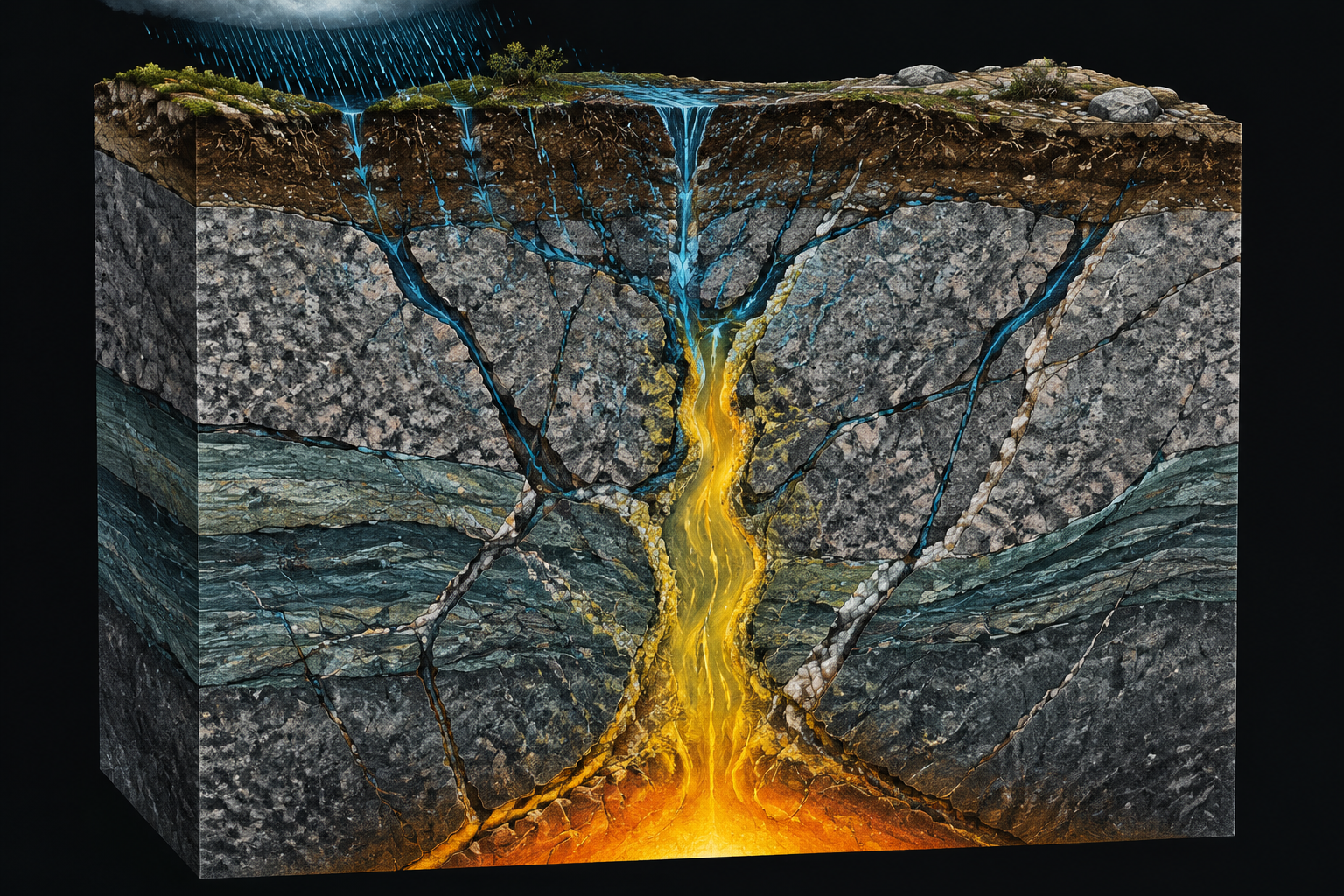
The circuit
Six stages, one continuous loop
A hot spring is not a body of water sitting underground. It is a flow — water on its way through. Tap through the stages below to follow a single drop from the moment it lands as rain to the moment it steams in the cascading pool.
Stage 1 of 6
Rain arrives
Singapore receives roughly 2,340 mm of rain a year — one of the highest totals of any city. Some runs off into drains, some is taken up by plants, and some soaks into the ground. That soaking-in is the spring's only input.
Without recharge there is no spring. This is why land use in the catchment matters.
Work it out
Why 70°C, and not 100°C?
You can estimate the temperature of the water using the geothermal gradient. If temperature rises by about 25°C for every kilometre of depth, and the water circulates to roughly 1.5–2 km before returning, the rock it meets should be somewhere between 65°C and 80°C. The measured 70°C fits that estimate closely — which is one piece of evidence that the water really is circulating to depth rather than being heated near the surface.
- Surface temperature
- ≈ 27°C
- Geothermal gradient
- ≈ 25°C per km of depth
- Depth of circulation
- ≈ 1.5 – 2 km
- Rock temperature at that depth
- ≈ 65 – 80°C
- Measured spring temperature
- 70°C
At sea level water boils at 100°C. The spring emerges at 70°C, well below boiling — which is why you see steam and bubbles but never a geyser. Steam appears because the water is far hotter than the air around it, not because it is boiling.
Reading the site
What to look for when you are there
At the cascading pool, notice that the water is hottest closest to the source and cooler as it spreads and shallows — that is the spring cooling in open air. Look for the mineral staining on the concrete and stone, and the faint sulphur smell. Both are traces of the journey the water has just made.
If you brought a thermometer, take a reading at two or three points along the channel and record them in your field journal. The pattern you find — a temperature gradient across the surface — is the same principle as the gradient underground, running in the opposite direction.
Key terms
- Recharge
- Water entering the ground and replenishing the underground store.
- Geothermal gradient
- The rate at which temperature rises with depth below the surface.
- Convection
- Circulation driven by density differences — warm fluid rises, cool fluid sinks.
- Permeability
- How easily a material lets fluid pass through it. Fractured granite can be permeable even though the rock itself is not porous.
- Meteoric water
- Water that originated as rain or snow, rather than from deep within the Earth.
Check your understanding
1 / 5