Background briefing · Chronos
A Village Called Ayer Panas
A hot spring is a fixed point. Roads, plantations, navies and housing estates can all change around it, but the water keeps arriving at the same temperature. Read the history of Sembawang through the one thing that never moved.
- 1909
- Springs found
- 1922
- Bottled as Seletaris
- 2020
- Reopened as a park
Orientation
A fixed point in a changing landscape
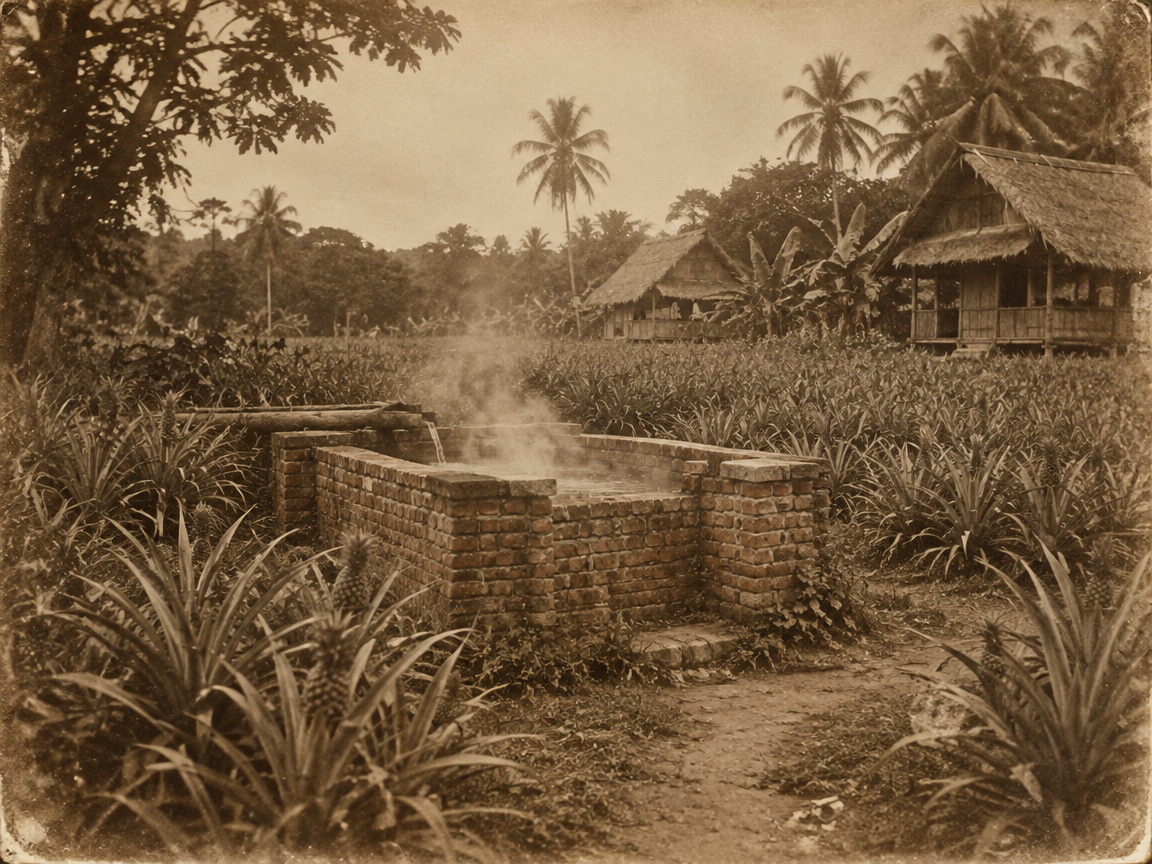
Sembawang today is a town of HDB blocks, a naval base and a road called Gambas Avenue. A century ago it was pineapple, rubber and gambier country, with kampongs scattered along the coast. Almost nothing in the landscape is the same — except the water.
That is what makes this site so useful to a geographer. Human activity changes quickly; geological and hydrological processes change slowly. When you find a place where the two meet, you can read the history of land use against the constancy of a natural system.
Timeline
Eight moments in the life of one spring
- 1909
Discovery in a pineapple estate
A Chinese merchant, Seah Eng Keong — son of the pioneer Seah Liang Seah — finds hot springs bubbling up in his pineapple estate in Sembawang. Three separate springs are channelled into one so the water gathers in a single place, and a well is built around it.
- 1910s
Kampong Ayer Panas
Villagers come to bathe, believing the water heals skin complaints and aching joints. The settlement becomes known as Kampong Ayer Panas — Malay for 'Village of Hot Water'. The spring is now a place name, not just a puddle.
- 1922
Industry arrives
The soft-drinks firm Fraser & Neave buys the site and builds a bottling plant nearby at Semangat Ayer. The mineral water is sold under the brand name Seletaris. A natural phenomenon becomes a commercial product.
- 1942
War stops the water
During the air raids a bomb falls near the well and the flow is temporarily interrupted. After the fall of Singapore, the Japanese military takes over the site and turns it into thermal baths — an onsen — for its own use.
- 1960
Good-luck baths and a shelved dream
Gamblers bathe before race days for luck. Villagers ask for the area to be developed as a spa resort, but Fraser & Neave shelves the idea: geologists at the time could not trace where the water came from, so no one could guarantee the supply.
- 1967
The plan that never happened
Fraser & Neave proposes a bathhouse, restaurants, a miniature golf course and a nature reserve. None of it is built. The site is left largely untouched and slowly forgotten by the city around it.
- 1990s–2000s
Held by the neighbourhood
The well and its red-brick enclosure survive. Residents keep arriving with pails, towels and eggs, even as Sembawang fills with new HDB blocks. Local memory keeps the place alive between official plans.
- 2020
Sembawang Hot Spring Park
The National Parks Board reopens the site on 4 January as a 1.1-hectare public park: a cascading pool, a footbath, and taps where visitors can cook eggs in the 70°C water. Free to enter, no booking, open daily.
Reading it critically
What the history tells a geographer
A resource becomes valuable when someone finds a use for it. For villagers it was a bathing place with a reputation for healing. For Fraser & Neave it was a bottling line. For the Japanese military it was a bathhouse. The water never changed; the demand did.
Uncertainty about the source blocked development. In 1960 geologists could not trace where the water came from, so investors could not be promised a reliable supply. The spa was shelved. Understanding the geology is what makes development possible — which is exactly what the next two briefings explain.
Local use kept the place alive. Between the failed plans of the 1960s and the park of 2020, the site survived on residents who simply kept turning up with pails. Heritage is often maintained by ordinary habit rather than official policy.
Key terms
- Ayer Panas
- Malay for 'hot water' — the name the kampong took from the spring.
- Kampong
- Malay for village or settlement.
- Onsen
- A Japanese hot-spring bath; the term used for the baths built during the Occupation.
- Seletaris
- The brand under which Fraser & Neave bottled the spring water from 1922.
Check your understanding
1 / 5